









Information
About your bottle
Why this page?
To learn more about your bottle, its composition, its recycling, and our recommendations for informed consumption.
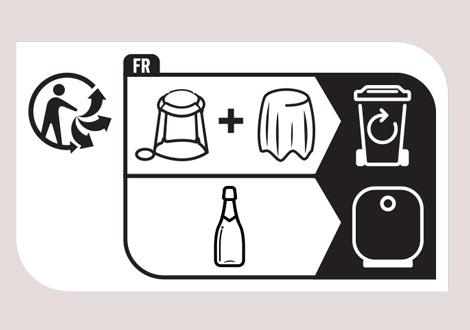
Sorting info - Recycling your bottle
The removable parts of the bottle, namely the aluminum cap and the cage (the plate and its wire cage), should be disposed of in your recycling bin.
The glass bottle and the cork should be placed in a glass recycling bin, either individual or communal.

Bottle cap recycling
The national sorting guidelines state that small caps should follow the glass bottle recycling stream to prevent them from ending up in the environment.
However, local cork cap recycling schemes exist, and they are waiting for you to take action so that used cork caps can be reborn as insulation materials, designer objects, and more.
The French Cork Federation invites you to drop off your used cork caps at the collection point nearest to your home, which you can locate by searching its official website.

Allergen information Champagne & sulfites
Our champagnes contain sulfites, which can sometimes be poorly tolerated.
Due to its antiseptic properties, sulfitation plays an important role in controlling undesirable indigenous yeast and bacterial populations during the production of Champagne wines. Due to its antioxidant properties, it helps preserve the physicochemical and sensory characteristics of the wines throughout vinification.

Calorie information
For 100 ml (or 10 cl) of Brut Champagne: 75 kcal and E = 317 kJ.
Did you know? The calories in a glass of wine or spirits come primarily from the alcohol molecule (varying according to the alcohol content). Next are the sugars present in the finished product, which depend on the raw materials used and the production process.
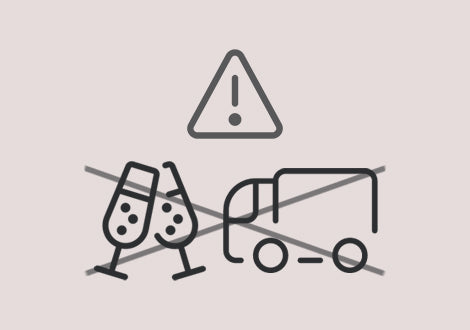
Responsible consumption
A 10 cl drink is equivalent to one unit of alcohol.
In France, it is illegal to drive with a blood alcohol level of 0.5 grams or higher (or 0.2 grams with a probationary license). It is best to refrain from drinking alcohol before getting behind the wheel or to test your blood alcohol level to make sure you are fit to drive.
In addition, you should refrain from consuming alcohol in the following situations:
- before the age of 18 (in France) or before reaching the minimum legal age required to consume/purchase alcohol, in accordance with the laws in force in your country of residence,
- during pregnancy and breastfeeding,
- while taking medication,
- if you need to operate tools or machinery (DIY, etc.),
- when participating in high-risk sports,
- if you have certain medical conditions.
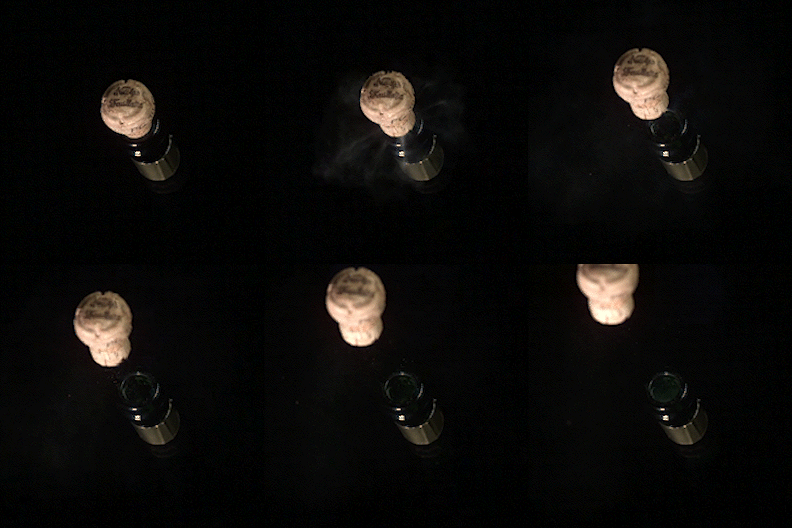
Pressurized container
Did you know? A bottle of champagne contains approximately 6 bars of pressure, which is equivalent to three times the pressure in a car tire.
This is why we recommend exercising the utmost caution when opening a bottle, and in particular, ensuring that the bottle is pointed away from anyone or anything that could be struck by the cork when it is expelled.
We also advise against sabrage, which, although it may seem spectacular, should be reserved for a circle of professionals under optimal safety conditions.