



Contrary to popular belief, cheese is not always the best companion for red wine. The tannins can accentuate certain bitternesses and weigh down the tasting experience. In contrast, the natural acidity of champagne and the finesse of its bubbles bring freshness, balance, and precision.
Which champagne for which cheese? The complete guide to pairings by cheese family
Cheese is one of the great pillars of French gastronomy. Creamy, melting, powerful or delicately lactic, it offers an infinite range of nuances. Given this richness, one question often arises when assembling a cheese board: which champagne should you choose to accompany each cheese?
Contrary to popular belief, cheese is not always the best companion for red wine. Tannins can accentuate certain bitternesses and weigh down the tasting experience. In contrast, champagne's natural acidity and the finesse of its bubbles bring freshness, balance, and precision.
From Brie to Roquefort, from Comté to aged goat cheeses, each cheese family has its ideal partner. Discover our complete guide to champagne and cheese pairings, featuring Nicolas Feuillatte cuvées that enhance each flavor profile.
Summary: which champagne for which cheese family?
An immediate overview to guide you before the family-by-family details.
Soft cheeses with bloomy rind
Examples: Brie, Camembert, Chaource
Recommended cuvée: Brut Millésime 2018
Soft cheeses with washed rind
Examples: Munster, Époisses, Langres
Recommended cuvée: Réserve Exclusive Demi-Sec
Goat cheeses
Examples: Crottin, Sainte-Maure, Pouligny
Recommended cuvée: Blanc de Blancs Millésime 2020
Uncooked pressed cheeses
Examples: Saint-Nectaire, Reblochon, Cantal
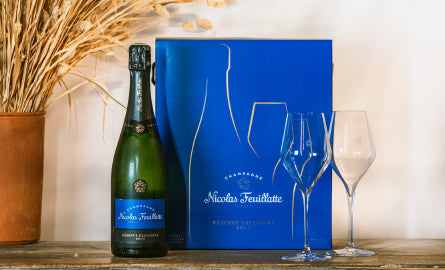
Recommended cuvée: Réserve Exclusive Brut
Cooked pressed cheeses
Examples: Comté, Beaufort, Gruyère
Recommended cuvée: Blanc de Blancs Millésime 2020
Blue cheeses
Examples: Roquefort, Fourme, Bleu d’Auvergne
Recommended cuvée: Réserve Exclusive Demi-Sec
Fresh cheeses
Examples: Faisselle, Brousse, Mozzarella
Recommended cuvée: Réserve Exclusive Brut
Exceptional cheeses
Examples: Aged Comté, Truffled Brie, Aged Parmesan
Recommended cuvée: Palmes d'Or 2009 Brut
The 3 golden rules of champagne / cheese pairings
Rule #1 — Champagne's acidity "cleanses" the fat from the cheese
Cheese is naturally rich in fat. Champagne acts as an ideal counterpoint thanks to its natural tension and the action of its bubbles. Between two bites, it refreshes the palate, restarts the sensations, and prevents any feeling of heaviness.
Dosage also plays an essential role in the success of the pairing. Particularly salty blue cheeses often call for a Demi-Sec champagne whose sweetness balances the power of the salt. In contrast, a fresh or lightly aged cheese pairs very well with a more tense Brut.
To better understand these balances, discover the different types of champagne dosage.
Rule #2 — Match the aromatic profiles, not just the strengths
A great pairing does not rely solely on intensity. It also arises from a dialogue between the aromas of the cheese and those of the champagne.
- Goat cheese + Blanc de Blancs: minerality against minerality, citrus against lactic notes.
- Brie + Millésime Brut: creamy against creamy, finesse against finesse.
- Roquefort + Demi-Sec: salt against sweetness, power against roundness.
- Aged Comté + prestige cuvée: depth against depth, patina against patina.
Rule #3 — Adapt the intensity, do not overpower the partner
Fresh cheeses and young goat cheeses require fine, precise, and delicate champagnes. Blue cheeses, washed rinds, or aged Comtés, on the other hand, require more structure, complexity, and sometimes a higher dosage.
The goal always remains the same: make the two products dialogue rather than allowing one to dominate the other.

The myth to debunk: "cheese is drunk with red wine"
The association between a cheese board and red wine is deeply rooted in French culture. Yet, this habit is not always the most relevant from a taste perspective.
The tannins in red wine often react with the proteins and fat of the cheese. The result can generate metallic sensations, excessive bitterness, or a general imbalance. Only some light reds, such as certain Pinot Noir or Gamay, really manage well.
Champagne, on the contrary, offers several natural advantages: an acidity that cuts through the fat, bubbles that lighten the tasting experience, and an absence of tannins likely to create aromatic conflicts.
Today, champagne and cheese pairings are among the most sought-after associations by sommeliers and gourmands. Far from being daring, they have become a benchmark.
Which champagne for each cheese family
For a Brie, a Camembert, or a Chaource (soft cheeses with bloomy rind)
Creamy, melting, and delicately woody, these iconic cheeses develop notes of fresh butter, Paris mushroom, and cream, sometimes accompanied by nuances of the forest floor when they are more aged.
The Brut Millésime 2018, the official Nicolas Feuillatte pairing for soft cheeses with bloomy rind, perfectly accompanies this generous texture thanks to its gastronomic profile marked by white plum, almond, and verbena.

🍾 Brut Millésime 2018
Symbol of a year of excellence · 6 years in the cellar · Official NF pairing
€42/bottle · View product sheet
💡 The sommelier's tip
Take your Brie out of the refrigerator 30 minutes before tasting to fully reveal its aromatic palette.
For a Munster, an Époisses, or a Langres (soft cheeses with washed rind)
These cheeses stand out for their moist and orange rind, as well as their marked aromatic power. Their profile oscillates between saline, animal, and sometimes slightly spicy notes.
The Réserve Exclusive Demi-Sec brings a gourmet counterpoint thanks to its notes of honey, candied fruit, and hazelnut. Its dosage naturally balances the vigor of washed rinds.
🍾 Réserve Exclusive Demi-Sec
The ideal companion for desserts and powerful cheeses
€35/bottle · View product sheet
💡 Did you know? — The Langres and its champagne bowl
The Langres has a natural bowl on top. A Champagne tradition consists of pouring a few drops of champagne into it before tasting.
For a Crottin, a Sainte-Maure, or a Pouligny (goat cheeses)
Goat cheeses stand out for their lactic freshness, their natural tension, and their notes of straw, hay, or ash depending on their aging.
The Blanc de Blancs Millésime 2020, made exclusively from Chardonnay, develops nuances of lime, verbena, and ginger that admirably prolong these flavors.
🍾 Blanc de Blancs Millésime 2020
100% Chardonnay · 5 gold medals 2025 · Elegance and minerality
€45/bottle · View product sheet
💡 The sommelier's tip
Serve the goat cheeses between 12 and 14 °C to express all their aromatic complexity.
For a Saint-Nectaire, a Reblochon, or a Cantal (uncooked pressed cheeses)
These mountain cheeses present a seductive balance between fruity, buttery notes and cellar nuances. Their moderate intensity makes them particularly versatile partners.
The Réserve Exclusive Brut naturally accompanies this family thanks to its fruity expression and balanced freshness.
🍾 Réserve Exclusive Brut
Emblematic cuvée of the NF style · Gold Mundus Vini 2025 · Gold Decanter 2024
€35/bottle · View product sheet
For a Comté, a Beaufort, or a Gruyère (cooked pressed cheeses)
Longly aged, these cheeses develop complex aromas of roasted hazelnut, dried fruit, brioche, and brown butter.
The Blanc de Blancs Millésime 2020 works here with a remarkable aromatic mirror effect.
🍾 Blanc de Blancs Millésime 2020
100% Chardonnay · Pastry notes mirroring hazelnut aromas
€45/bottle · View product sheet
💡 The sommelier's tip
Let the champagne open for a few minutes after uncorking to reveal more of its aromatic nuances.
For a Roquefort, a Fourme, or a Bleu d’Auvergne (blue cheeses)
Blue cheeses make up the most intense family on the board, with marked saltiness, a strong personality, and remarkable persistence.
The Réserve Exclusive Demi-Sec creates a spectacular balance between sweetness, honey, candied fruit, and saline power.

🍾 Réserve Exclusive Demi-Sec
Official NF pairing: Roquefort, Fourmes, Gorgonzola
€35/bottle · View product sheet
💡 The sommelier's tip
For a very powerful Roquefort, serve the Demi-Sec around 8 to 9 °C.
For a faisselle, a brousse, or mozzarella (fresh cheeses)
Delicate and not very salty, fresh cheeses favor sweetness and lightness. They require a champagne capable of respecting their subtlety.
The Réserve Exclusive Brut accompanies their freshness without ever taking over.
🍾 Réserve Exclusive Brut
Freshness and lightness to not overpower the delicacy of the fresh cheese
€35/bottle · View product sheet
For an aged Comté, a Truffled Brie, or an Aged Parmesan (exceptional cheeses)
This category brings together the great aged cheeses, with deep notes of dried fruit, umami, and noble spices.
The Palmes d’Or 2009 Brut meets this intensity with its complex aromas of fig, hazelnut, and vine peach.
🍾 Palmes d’Or 2009 Brut and its box
Prestige cuvée · 10 years in the cellar · The quintessence of the NF style
€131/bottle · View product sheet
📷 NF IMAGE: Varied cheese board with a Nicolas Feuillatte bottle in the background.
Cheeses to avoid with champagne
Case #1 — Cheeses that are too powerful served with a Brut Nature or Extra-Brut
A very aged Munster or a particularly powerful Maroilles can unbalance a very low-dosage champagne. The more intense the cheese, the more an adapted dosage becomes relevant.
Case #2 — Very ammoniated cheeses
A Camembert that is too far along, with dominant ammonia notes, can create an aggressive sensation when it comes into contact with the bubbles. It is better to favor a cheese that has reached maturity without excess.
Case #3 — Very acidic cheeses with an already lively champagne
Pairing a very acidic cheese with a particularly tense Blanc de Blancs can accentuate the sensation of acidity. A rounder Brut will often offer more balance.
Practical tips for serving champagne and cheese
Serve your cuvées between 8 and 12 °C depending on their style. Bruts generally appreciate a cooler temperature, while millésimes benefit from being slightly less cold.
To delve deeper into the subject, discover our guide on champagne storage: what temperature.
During the tasting, always start with the most delicate cheeses before finishing with the most powerful. Finally, favor a wine glass or a tasting glass rather than a narrow flute to better appreciate the aromatic dialogue between the champagne and the cheese.
Conclusion
Champagne and cheese form one of the most exciting pairings in French gastronomy. Thanks to the acidity, effervescence, and diversity of champagne styles, each cheese family can find its tasting partner. From fresh goat cheese to aged Comté, from melting Brie to powerful Roquefort, there is always a cuvée capable of revealing a new facet of the board.